Meridian Financial: What a 60-Day Operational Intelligence Audit Revealed
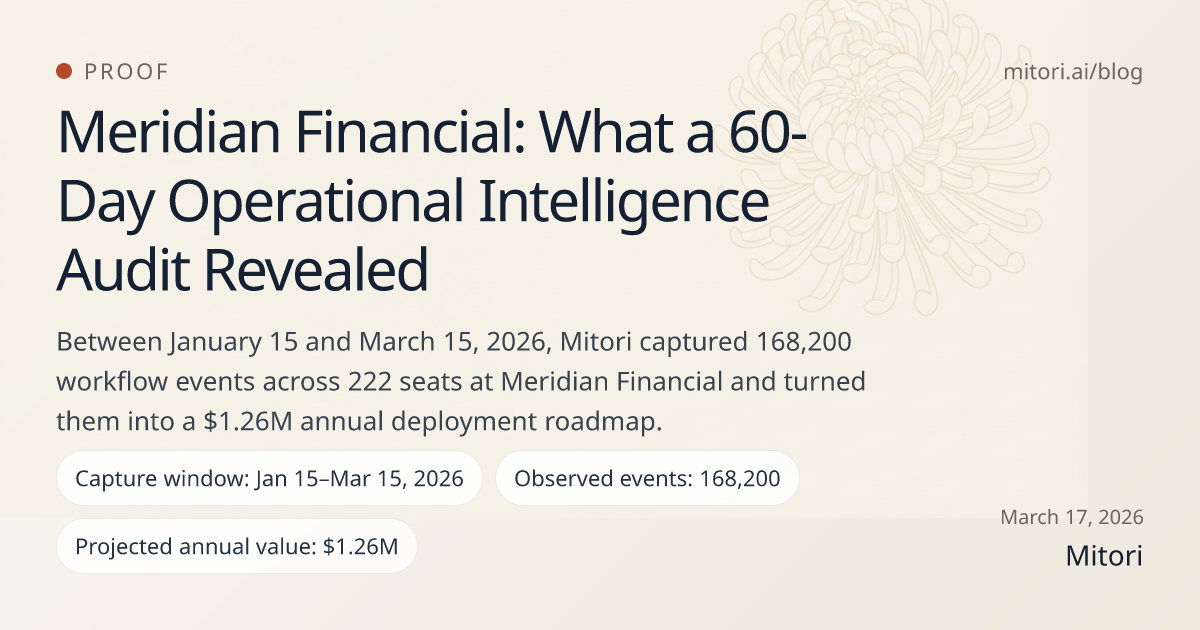
Capture window
Jan 15–Mar 15, 2026
Observed events
168,200
Projected annual value
$1.26M
Use this article with AI
Open a buyer-ready brief in your preferred assistant.
ChatGPT and Claude open with the prompt attached. Others copy the prompt to your clipboard first.
Mitori
Article assistant
Ask about this article
I can help you understand the key arguments, how they apply to your organisation, and what questions to ask next.
Powered by Mitori · Scoped to this article
Mitori observed Meridian Financial for 60 days, from January 15 to March 15, 2026, to reconstruct how work actually moved across finance, operations, customer service, legal, and HR. The objective was not to produce another workflow dashboard. It was to generate an approval-ready roadmap for where AI should be deployed first, with what value, and under what controls.
By Day 60, the audit had captured 168,200 events across 222 active seats, reached a 94% capture rate, and promoted six workflow families into the roadmap. The resulting base-case model identified 129,020 observed automatable hours and $1,259,804 in projected annual savings.
What the 60-day audit covered
Meridian Financial has 340 employees. Mitori observed workflow behavior across 222 active seats over a 60-day period, spanning finance, operations, HR, customer service, and legal/compliance. Observation focused on structural workflow evidence only: app usage patterns, window focus, and task timing, not keystrokes, screenshots, or document contents.
- Capture window: January 15 to March 15, 2026
- Active seats observed: 222
- Observed applications by Day 60: 24
- Consent / capture rate by Day 60: 94%
What Mitori found by Day 60
The observation graph stabilized around six promotable workflow families by Day 60. Those workflows were not guessed from templates; they were promoted only after recurrence, user coverage, and evidence thresholds were met.
- 168,200 observed workflow events
- 6 promoted workflows
- 129,020 observed automatable hours
- $1,259,804 projected annual savings in the base case
The highest-priority workflow
AP Processing ranked first because it combined the highest absolute savings with strong fit and early rollout readiness. The workflow spans seven steps, was observed across eight AP clerks, and averages 42 minutes per run. The main bottleneck is Validate against PO, a four-minute step with a 12% exception rate.
- Observed instances: 2,840
- Observed users: 8 AP clerks
- Average workflow duration: 42 minutes
- Modeled payback: 4 months
Why Claims Processing did not go first
Claims Processing still modeled meaningful value, but it stayed out of Wave 1 because the document-validation step had a 14% exception rate and settlement governance introduced harder policy constraints. The sequencing decision was driven by control maturity, not by lack of economic upside.
- Document validation exception rate: 14%
- Critical exception example: $48,200 settlement against a $25,000 policy limit
- Wave placement: Wave 2
What the roadmap looked like
Wave 1 focused on AP Processing and Email Triage & Response because they offered fast payback and lower governance drag. Wave 2 handled Claims Processing and Contract Review after policy hardening. Wave 3 expanded into onboarding and reporting once the control loop was proven.
Why this case matters
The Meridian case is a useful illustration of what operational intelligence should produce: a traceable evidence base, an explicit commercial case, a sequenced rollout order, and a control model that survives scrutiny from finance, operations, and technology leaders.
Next step
Review the proof surfaces
See the broader proof set behind Mitori’s audit, roadmap, and control model.
Related reading
CFO Decision Guide
How CFOs Should Decide What to Automate First
The real CFO question is not whether AI matters. It is which workflow deserves capital first, what confidence exists in the ROI, and what should wait.
Readiness
What Is AI Deployment Readiness?
AI deployment readiness is the point where workflow evidence, ROI, sequencing, integrations, and governance are strong enough for leaders to approve rollout with confidence.