What Is AI Deployment Readiness?
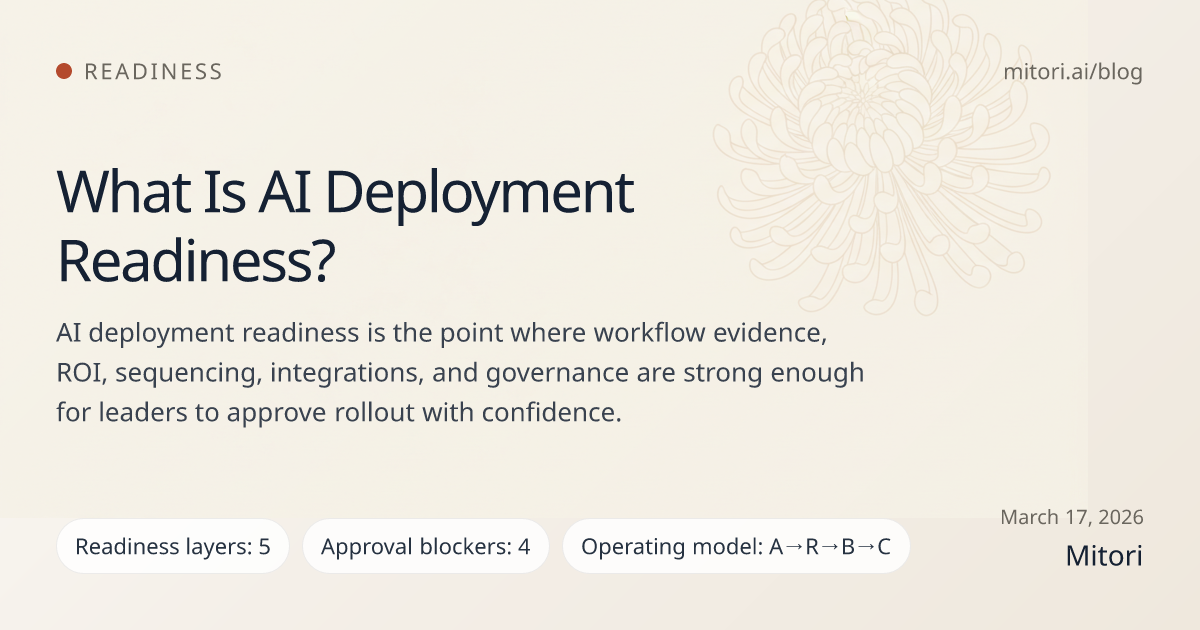
Readiness layers
5
Approval blockers
4
Operating model
A→R→B→C
Use this article with AI
Open a buyer-ready brief in your preferred assistant.
ChatGPT and Claude open with the prompt attached. Others copy the prompt to your clipboard first.
Mitori
Article assistant
Ask about this article
I can help you understand the key arguments, how they apply to your organisation, and what questions to ask next.
Powered by Mitori · Scoped to this article
Mitori is an operational intelligence platform built for teams that are past the question of whether AI matters and are now facing a harder question: are we actually ready to deploy it? Deployment readiness is not enthusiasm, and it is not a proof-of-concept demo. It is the point where leaders can approve rollout because evidence, economics, sequencing, and governance are all in place.
Most organizations overestimate readiness because they confuse use-case excitement with operational readiness. Real readiness appears only when a workflow has been observed, the value case is explicit, the rollout order is clear, and the control model is defined before build starts.
What AI deployment readiness actually means
AI deployment readiness means a workflow is understood well enough, valuable enough, and controlled well enough to move into implementation with executive approval. If any of those elements are weak, the organization is still in diagnosis rather than deployment readiness.
The five layers of readiness
- Workflow evidence: the team understands how the work actually happens across tools and handoffs.
- Economic case: the value, assumptions, and payback logic are explicit.
- Sequencing: leadership knows what should go first and what should wait.
- Integration feasibility: the required systems and contracts are viable for rollout.
- Governance: approvals, exceptions, and control boundaries are defined before build.
What false readiness looks like
| Readiness test | False readiness | Deployment readiness |
|---|---|---|
| Workflow understanding | Workshop assumptions and manager anecdotes | Observed workflow evidence across roles, tools, and handoffs |
| Business case | A headline productivity claim | ROI, ranges, and sensitivity tied to the workflow |
| Rollout sequence | A list of ideas with no order | An explicit roadmap with waves and rationale |
| Controls | Governance deferred until after implementation | Control boundaries designed before approval |
Readiness test
Workflow understanding
False readiness
Workshop assumptions and manager anecdotes
Deployment readiness
Observed workflow evidence across roles, tools, and handoffs
Readiness test
Business case
False readiness
A headline productivity claim
Deployment readiness
ROI, ranges, and sensitivity tied to the workflow
Readiness test
Rollout sequence
False readiness
A list of ideas with no order
Deployment readiness
An explicit roadmap with waves and rationale
Readiness test
Controls
False readiness
Governance deferred until after implementation
Deployment readiness
Control boundaries designed before approval
How Mitori measures readiness
Mitori measures readiness by combining workflow reconstruction, role-level economics, integration detail, policy constraints, and control expectations into one decision layer. That is what converts interest into approval-ready rollout.
Next step
Explore the product
See how Mitori turns readiness signals into a sequenced roadmap and governed deployment plan.
Related reading
Category Definition
What Is Operational Intelligence for AI Deployment?
Operational intelligence turns workflow evidence into a decision-ready roadmap. It shows enterprises what to automate, in what order, and under what controls.
Roadmap Planning
How to Build a Board-Ready AI Roadmap in 30, 60, or 90 Days
A board-ready roadmap is not a slide deck. It is a sequenced operating case that leaders can approve because the evidence, economics, and controls are explicit.