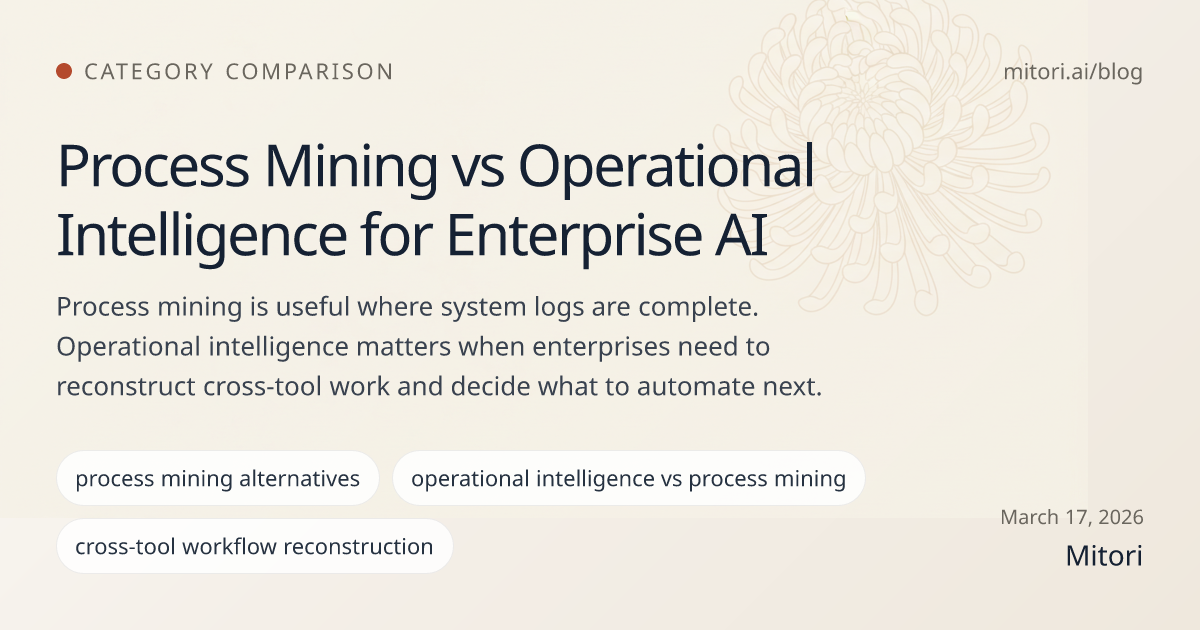
Process Mining vs Operational Intelligence for Enterprise AI
Use this article with AI
Open a buyer-ready brief in your preferred assistant.
ChatGPT and Claude open with the prompt attached. Others copy the prompt to your clipboard first.
Mitori
Article assistant
Ask about this article
I can help you understand the key arguments, how they apply to your organisation, and what questions to ask next.
Powered by Mitori · Scoped to this article
Mitori is an operational intelligence platform, not a process mining tool. That distinction matters because many enterprise AI decisions depend on work that happens outside clean event logs, across tabs, documents, approvals, and communication handoffs.
Process mining is useful when system traces are the truth. Operational intelligence becomes necessary when the truth of the workflow lives across tools and teams and still needs to become a deployment decision.
Where process mining helps
Process mining works well when a workflow is already captured in structured system logs. It helps teams understand system-level paths, cycle times, and conformance against expected models.
Where process mining stops
Large parts of modern enterprise work never make it into a single event stream. Switching between CRM, inbox, browser tabs, shared docs, spreadsheets, approvals, and manual review often defines the real workflow, but not the visible log.
- Knowledge work often spans multiple systems with no shared trace model.
- Exception handling usually happens outside the formal system-of-record path.
- The decision about where to automate next depends on workflow reality, not only system conformance.
Process mining vs operational intelligence
| Evaluation area | Process mining | Operational intelligence |
|---|---|---|
| Primary substrate | Event logs from systems of record | Observed workflow behavior across tools and handoffs |
| Cross-tool visibility | Often limited or dependent on integration quality | Designed for cross-tool workflow reconstruction |
| Buyer outcome | Insight into process behavior | A roadmap for what to automate first and how to govern it |
| Fit for rollout decisions | Indirect | Direct |
Evaluation area
Primary substrate
Process mining
Event logs from systems of record
Operational intelligence
Observed workflow behavior across tools and handoffs
Evaluation area
Cross-tool visibility
Process mining
Often limited or dependent on integration quality
Operational intelligence
Designed for cross-tool workflow reconstruction
Evaluation area
Buyer outcome
Process mining
Insight into process behavior
Operational intelligence
A roadmap for what to automate first and how to govern it
Evaluation area
Fit for rollout decisions
Process mining
Indirect
Operational intelligence
Direct
When to use each approach
- Use process mining when the core challenge is system-level conformance and process visibility inside a well-instrumented application landscape.
- Use operational intelligence when the challenge is deciding where AI should intervene across multi-tool, multi-role work.
Next step
See proof of the model
Review how Mitori turns observed work into an opportunity matrix, ROI case, and rollout plan.
Related reading
Category Comparison
Workflow, Workforce, and Operational Intelligence — What's the Difference?
Workflow intelligence and workforce intelligence describe useful views of work. Operational intelligence is the decision layer that turns that visibility into an AI deployment roadmap.
Governance
Governance-First AI Automation for Regulated Teams
Regulated teams do not need more automation ideas. They need a rollout model that survives audit, exception handling, and executive scrutiny.